The Role of Artificial Intelligence in Cybersecurity: Risks, Defensive Capabilities, and Emerging Directions
Introduction: The Growing Importance of AI in Modern Cybersecurity
Cyber threats today don’t just move faster and hit harder; they shape-shift and also morph in ways that leave old-school, manual defenses scrambling to keep up. Organizations are scattered across cloud networks (internet-based computing services that store and process data online). They also consist of or connect mobile devices (portable computing devices like smartphones and tablets), IoT gadgets (Internet of Things, physical devices that connect to the internet to collect and exchange data, such as smart thermostats or security cameras), and sprawling supply chains (complex networks of partners and vendors involved in producing and delivering goods and services). The attack surface keeps growing, and the old playbook just can’t keep up.
Attackers thrive in this chaos. They use automation (technology that performs tasks without human intervention, such as running attacks or scanning systems automatically) and anonymity (methods to avoid revealing identity online, like using fake credentials or encrypted networks) as their secret weapons to strike at scale and slip away unseen. Artificial Intelligence steps into the fray, a tool that can just as easily tilt the odds for defenders as for those on the attack.
AI’s relevance in cybersecurity lies beyond processing data quickly. It detects patterns, adapts on the fly, and enables real-time responses. As attackers become more sophisticated, defenders must adapt. For anyone new to the field, grasping how AI is reshaping cyber defense isn’t optional; it’s the foundation for both practice and research.
We’ll start with the basics, dig into the risks and defensive power of AI, tackle the ethical puzzles, and finish with a glimpse at what’s next.
Foundational Concepts: AI and Machine Learning in Cyber Defense
In cybersecurity, AI mostly shows up in the form of machine learning (ML). ML is all about systems that learn from data instead of following set rules. Old-school security tools rely on fixed patterns to catch threats, but they’re blind to anything new or unexpected.
Machine learning flips the script. These models chew through mountains of data, structured (organized, labeled data such as logs or records) or messy (unstructured data like emails or open text), to spot oddities (anomalies), sort behaviors, and even guess what an attacker might do next. In cybersecurity, you’ll see supervised learning (models trained with labeled data, e.g., known malware samples) for things like malware detection. Unsupervised learning (models that find patterns in unlabeled data) is used for catching weird network activity. Reinforcement learning (systems that learn through feedback and trial-and-error to improve decisions) is used for systems that adapt their defenses on the fly.
You’ll find these models everywhere, on endpoints, across networks, inside apps, and tracking user behavior. The payoff? Security teams stop playing catch-up and start getting ahead. But it only works if the data is solid, the context is sharp, and reality checks are routine. That’s what keeps the models honest.
The Adverse Use of AI in Cybersecurity
AI isn’t just in the hands of defenders. Attackers are using it too, automating their recon, sharpening their attacks, and sneaking past defenses. Picture phishing emails that feel personal and hit your inbox at exactly the wrong time. Algorithms, not people, are behind them. This new breed of attack leaves the old spray-and-pray tactics in the dust.
Adversarial machine learning takes it further. Attackers poison training data, slip in misleading inputs, or dissect algorithms to find weak spots. Sometimes, a tiny change fools a model into missing a real threat. For anyone relying on AI to keep things safe, that’s a serious headache.
Bottom line: AI does not eliminate cyber risk; rather, it changes the nature of these risks. Building resilient systems requires understanding both how AI enhances security and how it can be exploited.
AI as a Defensive Force Multiplier in Cybersecurity
AI works best as backup for human analysts. With the right support, security teams can spot what matters and move faster when trouble hits.
Threat Detection and Anomaly Analysis
AI-driven tools are quick to notice when something’s off, whether it’s a strange network spike, a rogue endpoint, or a user acting differently than usual (out-of-character behavior).
Unlike signature-based security systems (which rely on lists of known threats, known as “signatures,” to identify attacks), these models can spot attacks no one’s seen before. This is crucial for detecting zero-days (previously unknown vulnerabilities that have not been patched or identified by software makers) and stealthy threats. Research indicates that, in busy environments, machine learning often outpaces the old methods, especially when things get hectic.
Security Operations and Incident Response
In Security Operations Centers (SOCs), teams are responsible for monitoring and addressing security incidents. AI helps sort alerts, links related incidents (correlation, or linking different incidents to spot coordinated attacks), and adds context that would take humans hours to piece together. Automating repetitive tasks frees up analysts to zero in on complex problems.
Natural language processing (NLP, a technology for understanding and analyzing human language, like reading security reports) enables teams to sift through mountains of threat reports and hacker chatter efficiently. This data-driven prioritization (sorting alerts by likelihood or severity of risk using data models) aligns defensive resources with actual threat likelihood.
This approach is increasingly emphasized in frameworks from organizations such as NIST (National Institute of Standards and Technology) and ENISA (European Union Agency for Cybersecurity).
Behavioral Biometrics and Identity Security
Machine learning is also shaking up identity security(proving that a user is who they claim to be, using credentials or unique patterns), too. By tracking indicators, known as behavioral biometrics (using unique behavior patterns to verify identity, such as keystroke rhythm or mouse movement), it can provide ongoing verification that you are the legitimate user. The result? Defenses grow stronger against stolen logins, but users don’t have to jump through extra hoops.
Ethical, Operational, and Governance Challenges
Rolling out AI in cybersecurity isn’t just about tech; it’s about ethics, too. How do these models make decisions? Can we explain them? Who takes the blame when things go sideways? These questions matter most when privacy or access is at stake.
Bias in training data can lead to disproportionate false positives (incorrectly blocking legitimate actions or users) or false negatives (failing to detect actual threats), potentially affecting specific use cases. If the data feeding these models is biased (skewed or unrepresentative), the fallout can be real. Some users get flagged for no reason. Others sneak past. This is where cybersecurity, ethics, and policy need to work together, not in isolation.
Lean too hard on automation, and you risk missing what matters. That’s why frameworks stress keeping humans in the loop. AI should back up expert judgment, not replace it. For students, these challenges are a chance to dig into responsible AI development and real-world testing.
Future Trends and Research Opportunities
Looking forward, AI in cybersecurity is spreading out and drilling down. Researchers are trying federated learning to catch threats without sacrificing privacy. Graph-based models are mapping out complex attack paths. Some teams are even building systems that patch themselves as they go.
Another big move: mixing AI with threat intelligence to predict attackers’ next steps. But the arms race is far from over. Defending against attacks that target the AI itself is still an open challenge. The stakes? National security and critical infrastructure are on the line.
For students and researchers, the field is shifting fast. Success now means knowing data science, system security, and ethics. Real progress comes from connecting theory to hands-on testing and what actually works in the wild.
With all these changes, one thing’s clear: being ready for AI-driven shifts is now a must for anyone in cybersecurity.
AI is changing the game in cybersecurity. It’s not a magic fix, but it’s essential for building smarter, more flexible defenses. The real challenge is seeing both the risks and the rewards, and getting ready to use AI wisely.
For newcomers, jumping into AI and cybersecurity isn’t just about learning new tricks. It’s a chance to see how technology, risk, and trust connect in the digital world. Ask tough questions. Test boundaries. Push research forward and help build systems people can actually trust.
Skills Cybersecurity Students Should Develop
To work effectively with AI-driven security tools, students should focus on a blend of data literacy and traditional defensive tradecraft. You do not need to build AI models from scratch, but you must understand how they work, why they fail, and how attackers try to bypass them.
1. Basics of Machine Learning and Data Analysis
The goal here isn’t to become a data scientist, but to understand the math under the hood. You should be comfortable with how a model moves from raw data to a decision.
- Feature Engineering: Learn how security data (like a packet header or a file size) is turned into a numerical feature that a model can understand.
- Model Evaluation: Understand the difference between a False Positive (a benign file flagged as malicious) and a False Negative (a malicious file that slips through). In a professional SOC, a model with a $99\%$ accuracy rate might still be a failure if it generates 10,000 false alerts a day.
- Data Quality: Learn to spot garbage-in, garbage-out scenarios. If a model is trained on outdated traffic patterns from 2015, it won’t catch a modern ransomware strain.
2. Understanding AI Integration in Security Toolsets
Modern enterprise environments rely on a stack of tools that now come pre-loaded with AI modules. You need to know where the automation ends and your job begins.
- EDR (Endpoint Detection and Response): These tools live on laptops and servers. You should understand how they use behavioral heuristics to stop a process that suddenly starts encrypting files, even if that process isn’t a known virus.
- SIEM (Security Information and Event Management): The SIEM is the brain of the SOC. Learn how it uses AI to cluster thousands of isolated events into a single, coherent incident.
- UEBA (User and Entity Behavior Analytics): This is about spotting the insider threat. If an accountant suddenly starts accessing engineering servers at 3:00 AM, UEBA flags it as an anomaly based on that user’s specific historical baseline.
3. Log Analysis and Behavioral Detection
AI is great at spotting outliers, but it’s terrible at understanding why they happened. Your job is to provide that context.
- Telemetry Literacy: You should be able to read raw logs from Windows Event Viewer, Sysmon, or cloud providers like AWS CloudTrail.
- Pattern Recognition: While the AI might flag unusual PowerShell execution, you need to determine if that script was a legitimate admin task or a Living off the Land (LotL) attack, where a hacker uses your own tools against you.
4. Threat Modeling and Attacker Tactics (MITRE ATT&CK)
To defend a system, you have to think like the person trying to break it. The MITRE ATT&CK framework is the industry-standard periodic table of hacker techniques.
- Mapping AI to Tactics: Learn which stages of an attack, like Initial Access or Lateral Movement, are most easily spotted by AI, and which ones (like social engineering) still require a human eye.
- Adversarial Mindset: Study evasion techniques, such as adversarial perturbations, where an attacker makes tiny, invisible changes to a malware file to trick a scanner into thinking it’s a harmless PDF.
5. Scripting for Automation and Data Handling
Automation is the bridge between a mountain of data and a fast response.
- Python: The undisputed king of both AI and security. Use it to parse JSON logs, interact with security APIs, or write scripts that automatically isolate an infected host the moment an AI alert triggers. Here are the Python libraries every cybersecurity student should know:
- Data Processing and AI: Pandas, NumPy, Scikit-Learn, etc.
- Network Security & Analysis: Scapy, PyShark, Impacket, etc.
- Malware Analysis & Forensics: YARA-Python, Volatility, PEfile, etc.
- Automation & Infrastructure: Requests, Paramiko/Netmiko, Cryptography, etc.
You don’t need to master every tool in the box. Nail down a few, like Requests, Pandas, and Scapy, and you’ll be able to pull data from APIs, clean it up, and see how it travels across the network.
- Regex (Regular Expressions): This is a vital skill for filtering through massive datasets. A single well-crafted regex string can find a hidden IP address in a sea of ten million log entries.
Career Impact for Students
AI is reshaping cybersecurity roles, not eliminating them. The entry-level job is evolving away from mindless clicking and toward high-level investigation.
The Shift in the SOC
In the past, a Tier 1 Analyst might spend eight hours a day looking at Level 1 alerts, mostly low-level noise. Today, AI handles that noise.
- The New Entry-Level: Entry-level analysts now work alongside automated systems. Their value comes from interpreting AI-generated insights, investigating complex incidents that the model found suspicious but inconclusive, and improving detection logic so the system doesn’t make the same mistake twice.
- Human-in-the-Loop: You act as the sanity check. When an AI recommends blocking a critical business server because of unusual traffic, you are the one who decides if that block will save the company or shut down the payroll department.
Competitive Advantage
Students who understand both cybersecurity fundamentals, the boring stuff like TCP/IP networking and operating system internals, and AI concepts will have a massive advantage.
- Blue Teaming: You’ll be better at tuning defenses to reduce alert fatigue.
- Threat Hunting: Instead of waiting for an alarm to go off, you’ll use AI-driven datasets to proactively search for quiet attackers who are hiding in the noise.
- Incident Response: You’ll be able to use AI to reconstruct an attack timeline in seconds, rather than days.
The future of the field belongs to the Hybrid Defender, someone who treats AI as a powerful, yet fallible, teammate. By mastering these skills now, you aren’t just learning a tool; you’re future-proofing your career against the next decade of digital warfare.
The Essential Guide to Malware Research: Skills, Tools, and Career Pathways
The field of malware research is a critical component of cybersecurity, dedicated to analyzing, detecting, and mitigating malicious software. Malware research comprehension extends beyond mere threat analysis; it encompasses cultivating an anticipatory mindset that aligns with potential attacker actions. Given the growing reliance on digital infrastructure by businesses and individuals, malware research has become an indispensable skill set for cybersecurity professionals. This guide provides insights into malware research, required skills, tools, and career opportunities.
What is Malware Research?
Malware research involves studying different types of malicious software, understanding their behavior, and developing countermeasures. Researchers analyze malware samples, identify indicators of compromise (IoCs), and create detection strategies to prevent cyberattacks.
This process typically includes static and dynamic analysis, behavioral monitoring, and threat hunting. By reverse-engineering malware code and examining its execution in controlled environments, researchers uncover valuable insights that strengthen overall defense mechanisms.
Types of Malware
- Viruses – Self-replicating programs that attach to files. These often require user interaction to activate and can spread quickly across systems.
- Worms – Standalone programs that spread across networks. Unlike viruses, worms don’t need to attach to a host file and can propagate autonomously.
- Trojans – Malicious programs disguised as legitimate software. Trojans rely on deception, tricking users into executing them while they perform harmful actions in the background.
- Ransomware – Encrypts files and demands a ransom. This type of malware has grown rapidly, targeting everything from personal devices to corporate networks and critical infrastructure.
- Spyware & Adware – Secretly gathers user data or displays unwanted ads. While often viewed as less severe, these can be used for surveillance or data theft.
- Rootkits – Provide unauthorized access to a system. These are notoriously difficult to detect and often serve as gateways for more advanced attacks.
- Botnets – Networks of compromised devices used for attacks.Botnets are typically controlled remotely and used for DDoS attacks, credential stuffing, or spreading additional malware.
Understanding these categories helps researchers prioritize threats and tailor their analysis techniques accordingly.
Skills Required for Malware Research
- Reverse Engineering – Analyzing malware code using tools like IDA Pro, Ghidra, or OllyDbg. This skill allows researchers to unpack binaries and understand internal logic, often revealing how the malware propagates or avoids detection.
- Programming – Proficiency in programming languages such as Python, C, and Assembly. These languages are essential for scripting automation, analyzing exploits, or understanding system-level operations exploited by malware.
- Digital Forensics – Understanding how to investigate malware infections. Forensics helps trace the origin and timeline of infections, which is crucial for both prevention and legal action.
- Threat Intelligence – Staying updated on new malware trends and tactics. Researchers often rely on threat feeds, community reports, and dark web monitoring to anticipate new variants.
- Operating Systems & Networking – In-depth knowledge of operating systems including Windows, Linux, MacOS, etc., and network protocols is required. Because Malware often exploits OS-level vulnerabilities or uses network channels for command-and-control operations.
These core competencies form the foundation for any aspiring malware researcher and evolve constantly with the threat landscape.
Top Tools for Malware Analysis
- IDA , Ghidra – Disassembly and decompilation tools. These are essential for static analysis, allowing researchers to interpret assembly code and identify malicious functions.
- Wireshark – Analyzing network traffic. This helps identify communication between infected hosts and external servers, revealing command-and-control activity.
- YARA – Writing rules to identify malware families.YARA rules are widely used for automating detection across systems and identifying patterns across malware samples.
- Virtual Machine– Dynamic malware analysis. Running malware in a sandboxed environment helps observe real-time behavior without risking host systems.
- PEStudio – Static analysis for PE files. This tool flags suspicious characteristics within Windows executables, providing quick triage capabilities.
Combining these tools with a methodical approach enables efficient and safe malware analysis.
Career Opportunities in Malware Research
- Malware Analyst – Focuses on identifying and understanding malware behavior. Analysts analyze real-time threats and write detection signatures.
- Reverse Engineer – Specializes in deconstructing malware to find vulnerabilities. These experts uncover how malware evades detection and can provide insight into zero-day exploits.
- Threat Researcher – Monitors and analyzes evolving malware threats. They help organizations stay ahead by predicting trends and uncovering campaign patterns.
- Cybersecurity Consultant – Advises organizations on malware prevention and response. These professionals bridge the gap between technical findings and business strategies.
- Incident Responder – Investigates and mitigates cyber incidents. They act swiftly during breaches, ensuring minimal damage and thorough recovery.
Each of these roles requires continuous learning, collaboration, and a proactive approach to cyber defense.
How to Get Started?
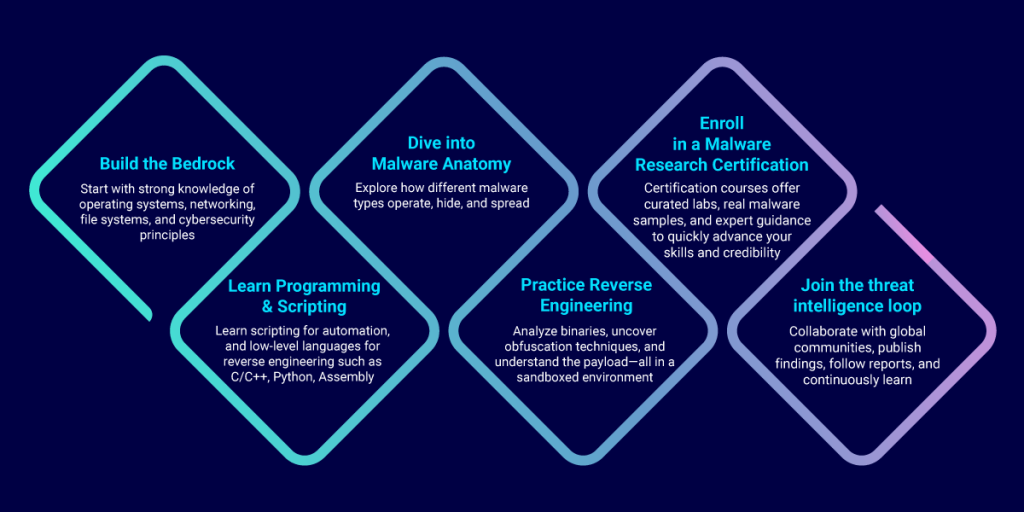
- Learn the Basics – Study cybersecurity fundamentals. Start with foundational knowledge in systems, networks, and security principles.
- Hands-on Practice – Set up a malware analysis lab with Virtual Machines (VMs). Practice analyzing samples in controlled environments using open-source or test malware.
- Take Certifications – We recommend you to get an industry-accepted professional certificate such as K7 Certified Malware Analystto establish credibility and validate expertise.
- Follow Experts – Read blogs, research papers, and attend security conferences. Platforms like Twitter, Reddit, and GitHub are great for real-time learning and community interaction.
Building a successful career in malware research involves balancing formal education, practical experimentation, and active participation in the infosec community.
Kickstart Your Malware Research Career
Conclusion
Malware research is an exciting and essential field within cybersecurity. With the right skills and tools, professionals can help protect organizations from evolving cyber threats. Whether you’re a beginner or an experienced analyst, continuous learning and practice are key to success in this field.
By delving into malware research, you not only acquire technical expertise but also contribute to a safer digital environment.
Top 10 Roles and Regions for Cyber Security Professionals
The global cyber security market is expected to reach $214.9 billion in 2024. The Indian cyber security market was $6.06 billion in 2023. A large products and services market creates a correspondingly large market for talent to power this industry. The supply of qualified cyber security professionals, however, hasn’t caught up with demand: the cyber security talent shortage worldwide has reached 4 million people, and is 790,000 in India.
Such a talent deficit indicates exciting and rewarding opportunities are available for cyber security professionals, but career planning requires understanding what roles exist in the industry and knowing where good opportunities are available.
Top 10 Roles/Jobs in Cyber Security
There are a wide variety of roles in the cyber security industry – so wide that a map of roles has been created. Studying the map will give you a bird’s-eye view of the industry and is useful for those exploring domains within the industry, but those interested in specific functions can examine our list of top 10 roles (in alphabetical order) in cyber security:
1. Application Security Engineer
An Application Security Engineer verifies that software can repulse cyber attacks. The Application Security Engineer requires coding knowledge and works with development teams to ensure that security is part of the DNA of the software that is being developed, rather than a layer that is added after the software is developed.
2. CIO/CISO
The Chief Information Officer/Chief Information Security Officer is responsible for defining organisational strategies that create and secure the information infrastructure of the enterprise with the goal of maximising stakeholder value. Their responsibilities include defining best practices for information handling by the IT team as well as the larger organisation, ensuring regulatory compliance and maximising return on IT investment.
3. Cyber Security Analyst
A Cyber Security Analyst examines an organisation’s security logs and other records to proactively identify and mitigate cyber threats. Such an analyst requires a sound understanding of malware, the Tactics, Techniques, and Procedures (TTPs) used by threat actors, and the way information is generated, stored, and transmitted by the enterprise.
4. Cyber Security Manager
The Cyber Security Manager is responsible for managing the organisation’s cyber security based on the strategic security objectives defined by the organisation. The role includes communicating with other stakeholders, enforcing the enterprise’s security standards, ensuring regulatory compliance, staffing the IT team with qualified cyber security personnel, and maintaining cyber security expenditure within the organisation’s budget.
5. Information Security Analyst
An Information Security Analyst examines cyber security both within and outside the organisation, anticipates cyber attacks, verifies if the organisation’s cyber defence infrastructure is capable of stopping cyber attacks, and recommends and implements cyber risk mitigation measures. The Information Security Analyst should be able to simultaneously managed both functional and strategic responsibilities.
6. Malware Analyst
A Malware Analyst reverse engineers malware samples to understand how the malware works and to develop cyber defences. A Malware Analyst has deep technical expertise in operating systems, static and dynamic analysis of malware, and obfuscation techniques used by threat actors.
7. Network Security Engineer
A Network Security Engineer ensures that the enterprise network is stable, efficient, and secure. The Network Security Engineer should be able to design and audit networks to maximise availability, prevent network intrusions, and maintain the integrity of information transmitted through the network.
8. Penetration Tester
A Penetration Tester simulates attacks on enterprise IT assets using white hat hacking techniques to verify if the organisation’s cyber defences are effective against real-world cyber threats. A Penetration Tester requires extensive knowledge of multiple operating systems, pentesting tools, and hacking techniques; they should also be able to gather evidence and write reports that enumerate their findings.
9. Security Architect
A Security Architect analyses the enterprise’s strategic objectives and compliance requirements, understands the current and future IT infrastructure requirements, and designs and deploys security architecture to safeguard the organisation’s information assets while enabling growth and productivity.
10. Security Consultant
A Security Consultant evaluates the organisation’s IT ecosystem and advises the organisation on the cyber security strategy, standards, technologies, and policies that must be implemented to secure enterprise information infrastructure. A Security Consultant may function as an independent contractor who works with multiple organisations on specific projects.
Top 10 Cities for Jobs in Cyber Security
Cyber attacks are an international problem and, therefore, opportunities exist worldwide but these opportunities are not equally distributed across all locations. Greater opportunities tend to be available in some cities that have a well-established technology industry or are critical hubs for international commerce.
A discussion on the 15 Best Cities for Cyber Security Jobs is available. We list the top 10 cities to provide a snapshot of the international careers that may be accessed by a cyber security professional:
- Dubai, United Arab Emirates
- Amsterdam, Netherlands
- Berlin, Germany
- Sydney, Australia
- Toronto, Canada
- Zurich, Switzerland
- London, United Kingdom
- San Francisco, United States of America
- Seattle, United States of America
- New York, United States of America
Salaries for cyber security professionals can vary across these cities from an average of $119,685 for a cyber security specialist in Amsterdam to a median pay of $130,000 in Seattle.
The cyber security industry offers challenging and remunerative careers for professionals that have the knowledge and experience to counter escalating cyber attacks. K7 Academy provides cyber security training with 75% hands-on learning, enabling aspiring cyber security specialists to analyse malware in a real-world threat lab environment and gain job-aligned certifications. Contact Us for more information on how we can help you begin or progress in your cyber security career.
How You Can Enter The Vast World Of Cybersecurity Opportunities
Why should you consider a career in cybersecurity? Other than the satisfaction of keeping the world safe from digital destruction, cybersecurity is a field where opportunities are increasing quicker than the availability of skilled professionals, and businesses are concerned that the shortage of talent is making it difficult to secure their operations. Recent news about cybersecurity jobs include
- 92% of surveyed organisations believe that demand for technical cybersecurity individual contributors will increase next year
- Entry-level positions have salaries in the Rs. 3-6 lakh range, and senior professionals can earn Rs. 50-80 lakhs
The increase in demand for cybersecurity talent is driven both by the relentless increase in cyberattacks and cybersecurity mandates from regulatory bodies, such as the Securities and Exchange Board of India (SEBI) requiring Stock Exchanges, Clearing Corporations, and Depositories to conduct regular vulnerability scanning.
We have seen why you should build a career in cybersecurity. Now let us examine how.
How You Can Enter the Cybersecurity Industry
Cybersecurity is a field that involves specific skills, and therefore requires specialised education and training. Entering this industry, and building a career, will be easier if you first research and plan, and then execute your plan.
Understand All the Opportunities Available
Cybersecurity is not a single skill or qualification. You may make your career in Vulnerability Assessment and Penetration Testing (VAPT), or you may prefer malware analysis, or choose any other domain within cybersecurity. To choose your path, you will first need to map the opportunities available – or at least study the map, as it has already been created. This map proves that cybersecurity is a vast world with a wide variety of opportunities that keep expanding. Research the industry and understand its various domains and roles; you will be able to find your niche no matter where your interests lie, due to the diversity of available opportunities.
Develop Foundational Skills
Cybersecurity revolves around computing technology and you will need a sound understanding of the digital technology ecosystem. Being good at mathematics and programming will help you advance in this field, and you will also need to be familiar with the components of digital technology infrastructure, such as networking, operating systems, and data storage, as these areas are attacked by threat actors and you will need to understand this infrastructure to defend this infrastructure.
Develop Cybersecurity Skills
We have already mentioned that cybersecurity requires specialised education and training. It follows that such training can only be obtained from specialised training centres. Universities and other centres of learning provide courses in cybersecurity. When choosing an institution, look for training centres that are affiliated with cybersecurity organisations and can provide hands-on experience with the cybersecurity tools that you will be expected to use in your cybersecurity career. Being able to work with malware samples will also give you vital experience in isolating, handling, and analysing malware, which are skills you will need when you defend organisations against cyberattacks. An institution that also performs malware research is preferred as you will be exposed to the latest malware and the Tactics, Techniques, and Procedures (TTPs) used by cyberattackers.
K7 Academy provides industry-aligned cybersecurity training with malware research and hands-on exposure to industry tools.
Familiarise Yourself with Standards and Regulations
Cybersecurity is not just a technical field – it is also an essential part of compliance. The organisation that you wish to join may need to comply with GDPR, HIPAA, or PCI-DSS, or may choose to implement the NIST Cybersecurity Framework or adhere to ISO 27001. Familiarising yourself with common cybersecurity standards and regulations will make you a better fit for the requirements of potential employers.
Gain Real-world Expertise
There is nothing like rolling up your sleeves and working on stopping an actual cyberattack to teach you the nuances of creating effective cyber defences – and employers know this, which is why they look for experienced candidates. On-the-job experience can be acquired through internships where you can develop the real-world skills required to counter cyberattacks on a daily basis. Look for cybersecurity courses, such as the courses from K7 Academy, that offer such internships.
Follow Cybersecurity News
Having up-to-date knowledge is essential for career growth, and is particularly important in cybersecurity where cyberthreats, cyber defences, and regulations are constantly evolving. Following cybersecurity news is an easy way to be familiar with the latest ways in which threat actors compromise organisations and the measures that are developed to counter them.
Develop Problem Solving Skills
A cyberattack is a problem that a cybersecurity professional is expected to solve and therefore problem solving skills are highly valued in this industry. The ability to analyse situations, harness critical thinking to identify weaknesses in technology ecosystems, and employ logic when faced with a cybersecurity incident can be developed through practise. Cyber defence is a form of detective work, and you must learn to think like a detective.
Develop Communication Skills
When all functions in an enterprise become digitally enabled, the entire enterprise becomes vulnerable to cyberattacks and cybersecurity professionals will need to interact with stakeholders at various seniority levels across all departments. The ability to communicate effectively, in speech and in writing, and the ability to receive communication well, by listening and reading attentively, will help you be, and be perceived as being, a highly capable cyber defender.
K7 Academy helps aspiring cybersecurity professionals gain job-aligned certifications with hands-on learning programmes that utilise real-world cyberthreats. Contact Us to learn more about how you can access satisfying and rewarding careers in cybersecurity.
The Role of Security Awareness in the Enterprise: Educating Your Employees
Two recent cybersecurity incidents illustrate how employees can be targeted by threat actors or how employee action can result in a data breach:
Two recent cybersecurity incidents illustrate how employees can be targeted by threat actors or how employee action can result in a data breach:
- Hackers accessed internal systems of a video game company after sending an SMS phishing text to an employee
- A software company suffered a data breach after hackers obtained an employee’s credentials that were mistakenly posted in a public repository
Both these cyberattacks could have been avoided through greater security awareness which can be achieved through employee education. Before we explore cybersecurity education for employees in the enterprise, let us first understand how employee action can result in cyberattacks.
How Humans Can Cause Cyberattacks
An employee can cause a cyberattack through
- Human Error – This could include sharing a password, leaving a laptop unlocked and unattended in a public place, or discussing problems faced in the IT infrastructure of the organisation in a technology forum in a way that allows the organisation to be identified
- Human error also includes creating business processes without following cybersecurity best practices in process design
- Falling for Phishing – Phishing is a form of social engineering where the victim is manipulated into performing an action that has an adverse impact on the organisation, such as transferring funds to the attacker or opening an email attachment laced with malware. 91% of all cyberattacks are estimated to being with a phishing email
- Intentional Action – An employee may deliberately initiate or enable a cyberattack against their employer due to dissatisfaction or greed.
How Employee Education Can Prevent Such Attacks
Educating employees can help mitigate the human factor in cyberattacks. We will examine how education addresses each of the factors mentioned above.
Human Error
Many enterprises do try to create employee cybersecurity awareness by putting up posters that warn against sharing of passwords or by conducting a floor walkthrough at lunchtime to identify unlocked computers. Such measures have limited success as they do not make employees identify with the need for cybersecurity. Employee education that focuses on how enhanced cybersecurity benefits the employee as well as the organisation can help employees understand the importance of cybersecurity from a practical viewpoint and apply their training when completing their tasks.
Employee education does not imply a one-size-fits-all approach. Training programmes can be customised to suit the needs of teams e.g., the IT team will require training that emphasises the technical aspects of cybersecurity, such as identifying and closing gaps in cyber defences and investigating malware reports, to improve their ability to build and maintain effective cybersecurity; end users will not require such technical training and will be better served by education on cyber hygiene.
Employee education also enables decision makers to adopt a ‘shift-left’ approach and prioritise cybersecurity in their initiatives. This can range from choosing vendors who have a track record of providing frequent and timely security updates for their products, to incorporating cybersecurity in strategic planning.
Falling for Phishing
As explained previously, phishing is a form of social engineering. Phishing may be difficult to counter with technology solutions, such as endpoint protection, as it may not involve malware or malicious links, and may occur on an employee’s device through their personal use of web resources. For example, the attacker may approach a member of the IT team on LinkedIn posing as a recruiter; a job interview may be conducted with questions designed to gain information on the IT infrastructure of the target organisation and that information may be used to launch an attack.
Employee education that highlights the various phishing methods used by threat actors to gain the victim’s trust will help employees spot phishing attempts in their personal and professional lives. Employee education also helps decision makers realise that corporate culture can play a role in making phishing easier to accomplish, and change how the organisation functions. For example, a culture where the boss is obeyed without question enables phishing as the attacker can impersonate the boss via email and send a request for transfer of funds to the attacker’s bank account; organisations that are aware of this risk can change their culture and introduce a maker-checker system for all payments including payments requested by senior leadership.
Intentional Action
Intentional action by employees, also known as internal attacks, is the most difficult to defend against as the attacker is familiar with and has access to the organisation’s infrastructure. The attacker may even be a senior employee who enjoys elevated privileges that can be used to cause severe operational disruption.
Employee education may not stop a disgruntled employee from launching an attack, but can help other employees spot the impending attack and take preventive action e.g., an employee may become suspicious due to unusual activity from the attacker, such as requesting access to data unrelated to their responsibilities or attempting to enter restricted areas.
Employee education can also make management aware of the potential for intentional malicious action and change internal practices and processes to avoid concentration of power in the hands of a few by implementing a system of checks and balances, mandating the principle of least privilege at all levels of the hierarchy, and requiring elevated privileges to be removed as soon as the task for which they are required is completed.
Frequency of Employee Education
Employee education cannot be a one-time exercise as cyberattacks keep evolving and employees’ knowledge and awareness of cyberattack techniques will need to be refreshed. Formal training, in the form of a session conducted by knowledgeable cybersecurity practitioners, will need to be conducted at least once a year. Other forms of education, such as email advisories, can be utilised as dictated by the urgency of the threat.
K7 Academy delivers enterprise cybersecurity education for technical and non-technical audiences, backed by K7’s 30+ years of expertise in cybersecurity. Contact Us to learn more about our cybersecurity training programmes and how we can help your organisation counter the human factor in cyberattacks.